Australian aged care statistics show that between 2020 and 2025, Australia’s population aged 80 and over grew by more than 19 per cent. The number of residential aged-care places also increased, but much more slowly, reducing the number of places relative to the older population.
How many residential aged-care places are there in Australia?
Between 30 June 2020 and 30 June 2025, Australia’s estimated resident population aged 80 and over increased by 201,427 to 1,247,222. That was an increase of 19.26 per cent, based on Australian Bureau of Statistics population data.
Over the same five-year period, the number of operational places in ordinary residential aged care rose from 217,145 to 224,493. That was an increase of 7,348 places, or 3.38 per cent, based on GEN Aged Care Data.
In this analysis, an aged-care place refers to a place within an operational residential aged-care service. It is a measure of residential aged-care capacity, not a measure of whether a bed is vacant or immediately available to a prospective resident.
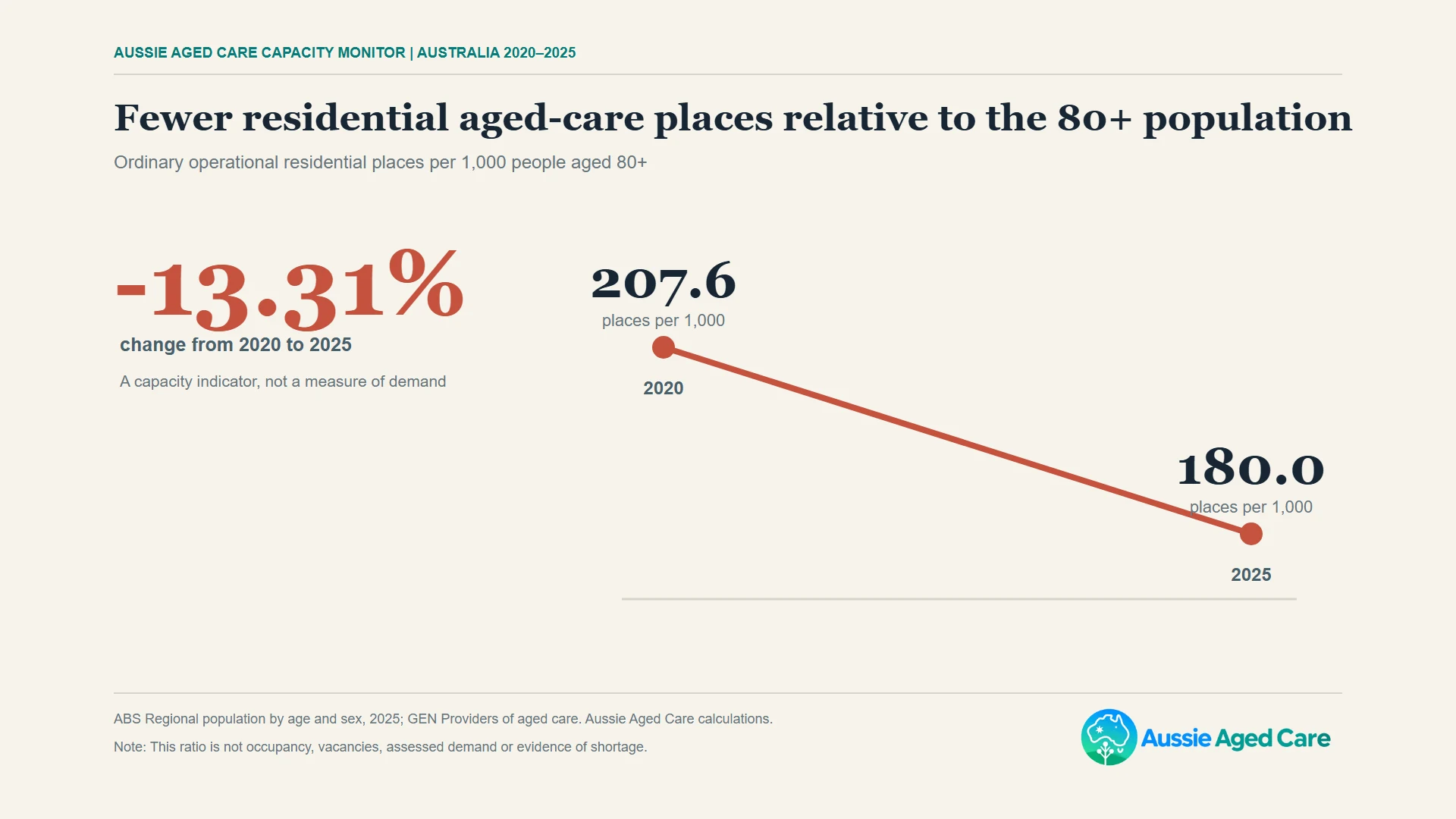
With the population aged 80 and over growing substantially faster than the number of residential aged-care places, the national ratio of places to older Australians declined.
In 2020, there were 207.6 aged-care places for every 1,000 Australians aged 80 and over. By 2025, that had fallen to 180.0 places per 1,000 — a decline of 13.31 per cent.
What happened across Australia’s states and territories?
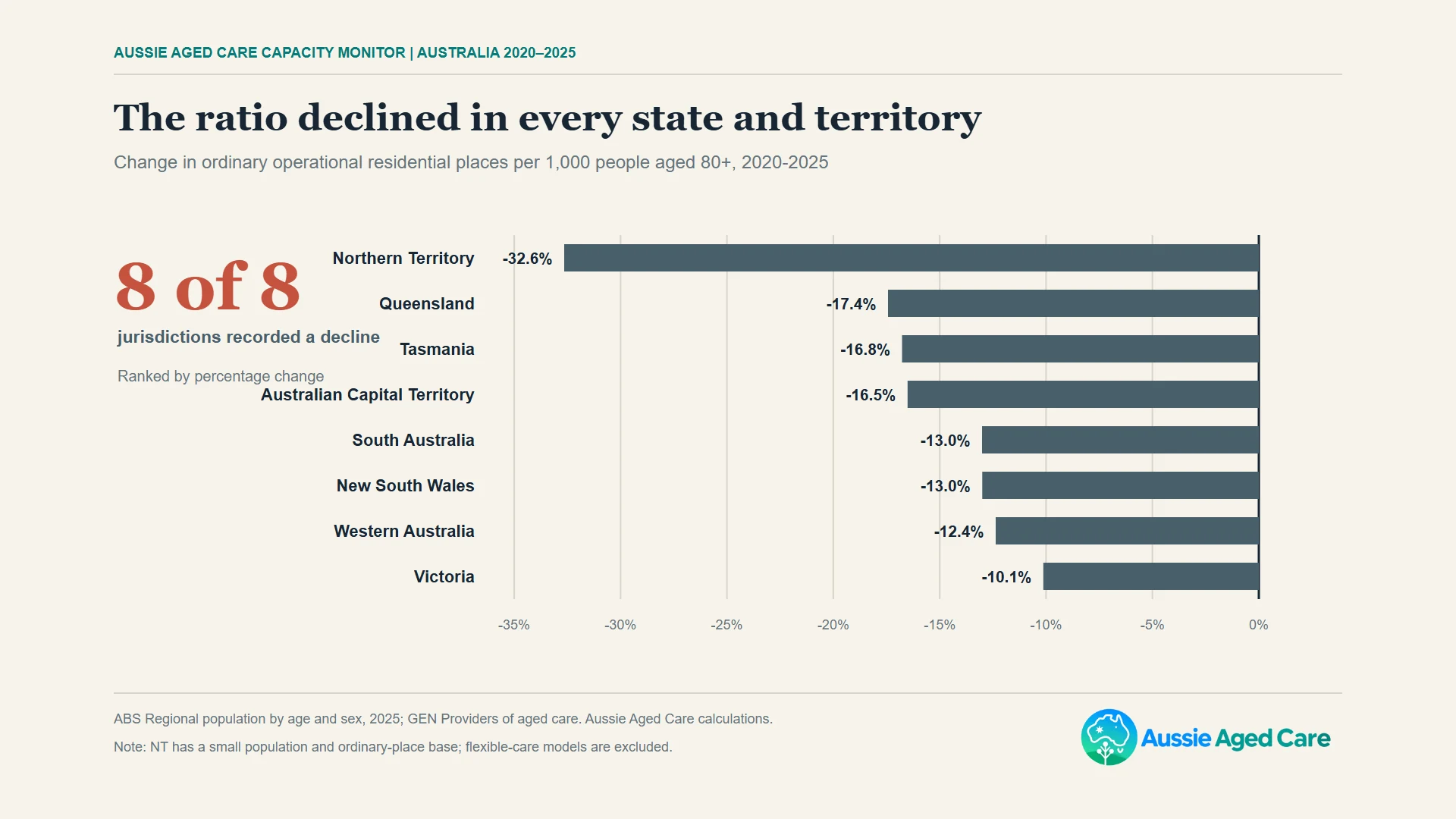
Population growth among people aged 80 and over outpaced growth in residential aged-care places across all eight states and territories, although the size of the change varied.
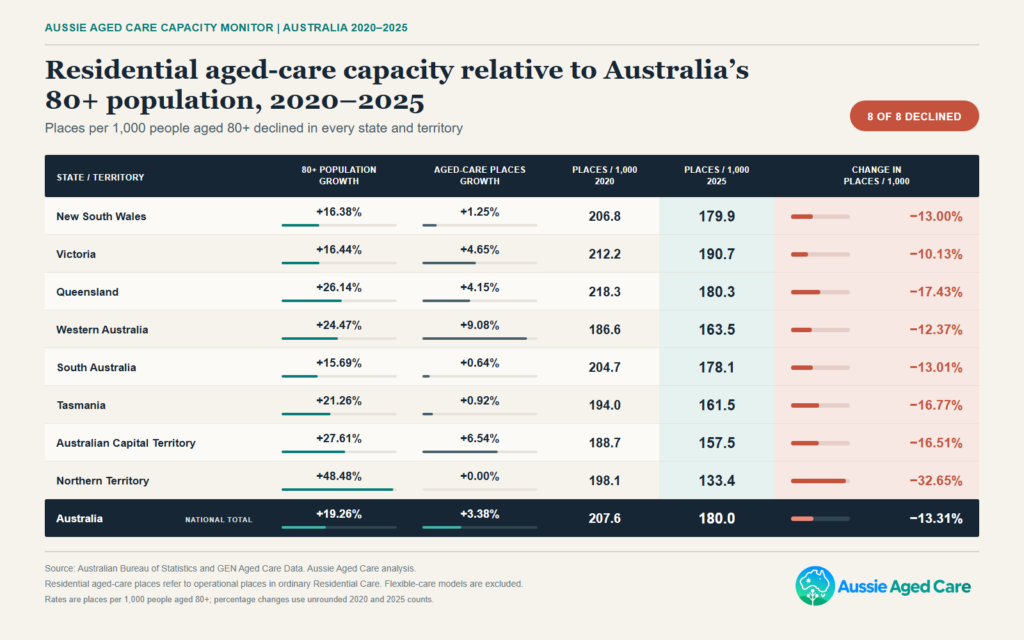
Western Australia recorded the strongest growth in aged-care places, increasing capacity by 9.08 per cent. But its population aged 80 and over grew considerably faster, increasing by 24.47 per cent.
New South Wales recorded the largest absolute increase in its 80-plus population, adding 57,263 people over the five years, while the number of aged-care places increased by 904.
In Tasmania, the population aged 80 and over grew by 21.26 per cent, while the number of aged-care places increased by 0.92 per cent.
Queensland recorded a 17.43 per cent decline in its ratio of aged-care places to people aged 80 and over, while Victoria recorded a smaller decline of 10.13 per cent.
The Northern Territory recorded the largest percentage decline in the ratio, at 32.65 per cent. This result should be treated cautiously because of the territory’s relatively small number of ordinary residential aged-care places and the exclusion from this analysis of flexible-care models used in the territory.
How fast did Australia’s 80-plus population and aged-care capacity grow?
Across Australia, growth in residential aged-care places did not keep pace with growth in the population aged 80 and over between 2020 and 2025.
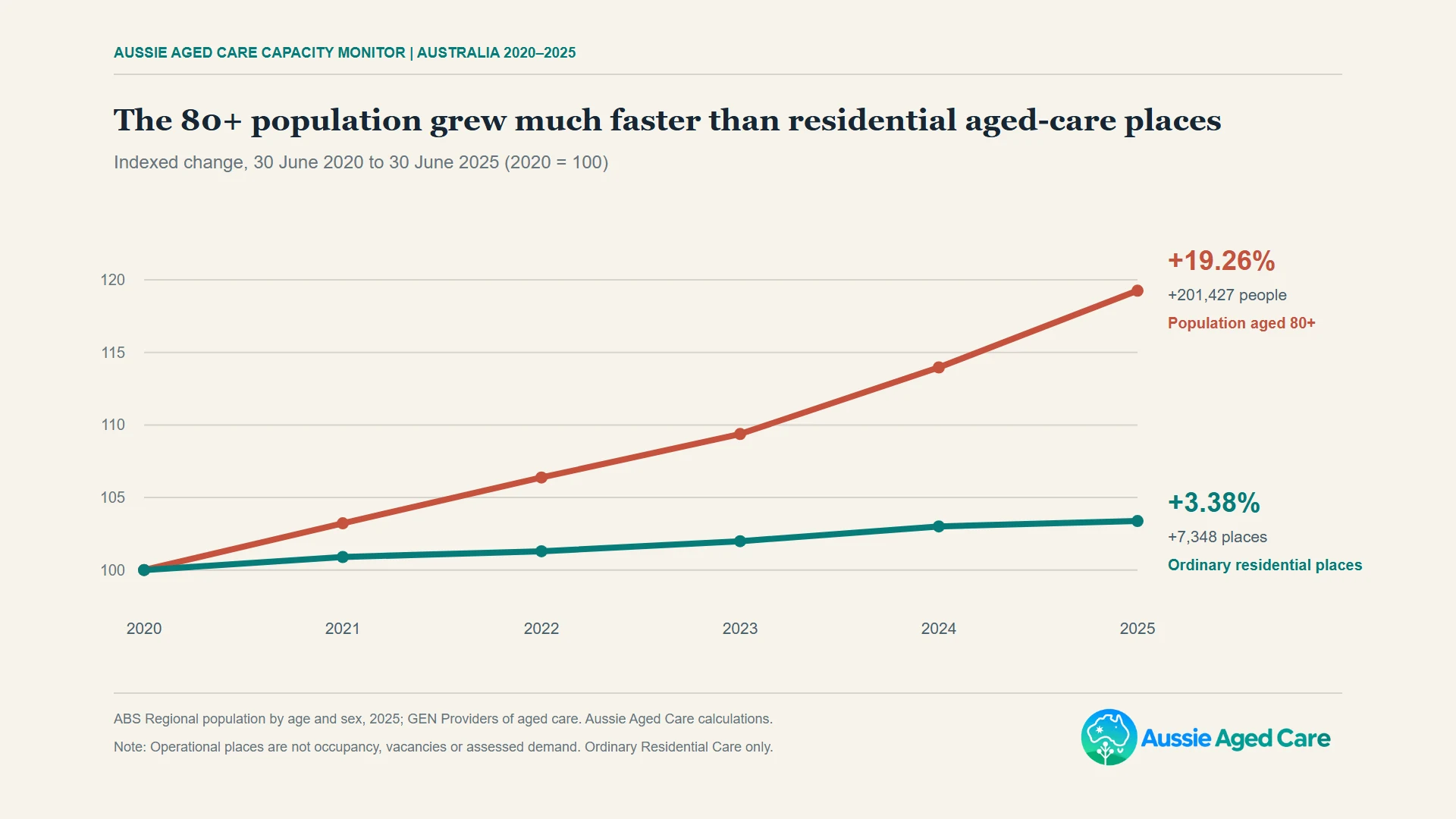
Nationally, the 80-plus population grew by 19.26 per cent while the number of aged-care places grew by 3.38 per cent. The result was a 13.31 per cent decline in the number of residential aged-care places per 1,000 people aged 80 and over.
The same broad pattern occurred in every state and territory.
What do these Australian aged-care statistics not show?
This analysis measures residential aged-care capacity relative to population. It does not measure demand.
A falling number of aged-care places per 1,000 older Australians does not, by itself, prove there is a shortage of residential aged care or unmet demand.
The data does not measure occupancy, vacancies or waiting times for residential aged care, and it cannot show whether an individual family will be able to find a suitable place when they need one.
The measure also does not account for individual care needs, consumer preferences or the use of home-based and other forms of aged care outside the residential services included in this analysis.
How were these Australian aged-care statistics calculated?
Aussie Aged Care compared Australian Bureau of Statistics estimated resident population data for people aged 80 and over with GEN Aged Care Data on operational places in services classified as ordinary Residential Care.
The analysis uses aligned 30 June observations from 2020 to 2025. Details about the ABS population estimates are provided in the source methodology listed below.
The residential aged-care measure excludes Home Care, Multi-Purpose Services, National Aboriginal and Torres Strait Islander Flexible Aged Care, Transition Care, Short-Term Restorative Care and other flexible-care models.
National figures were calculated by summing state and territory counts.
Sources
- Australian Bureau of Statistics — Regional population by age and sex, 2025
- GEN Aged Care Data — Providers of aged care
- Australian Bureau of Statistics — Regional population by age and sex methodology, 2025
Source: Australian Bureau of Statistics and GEN Aged Care Data. Aussie Aged Care analysis.